Technology Copy
Why Synthetic Audience a New Era in Consumer Insights
Socialtrait’s new U.S. patent confirms what forward-looking brands already know: scalable consumer simulation is the future of testing ideas, campaigns, and creative at speed.

25 Jan 26
・
8 min read
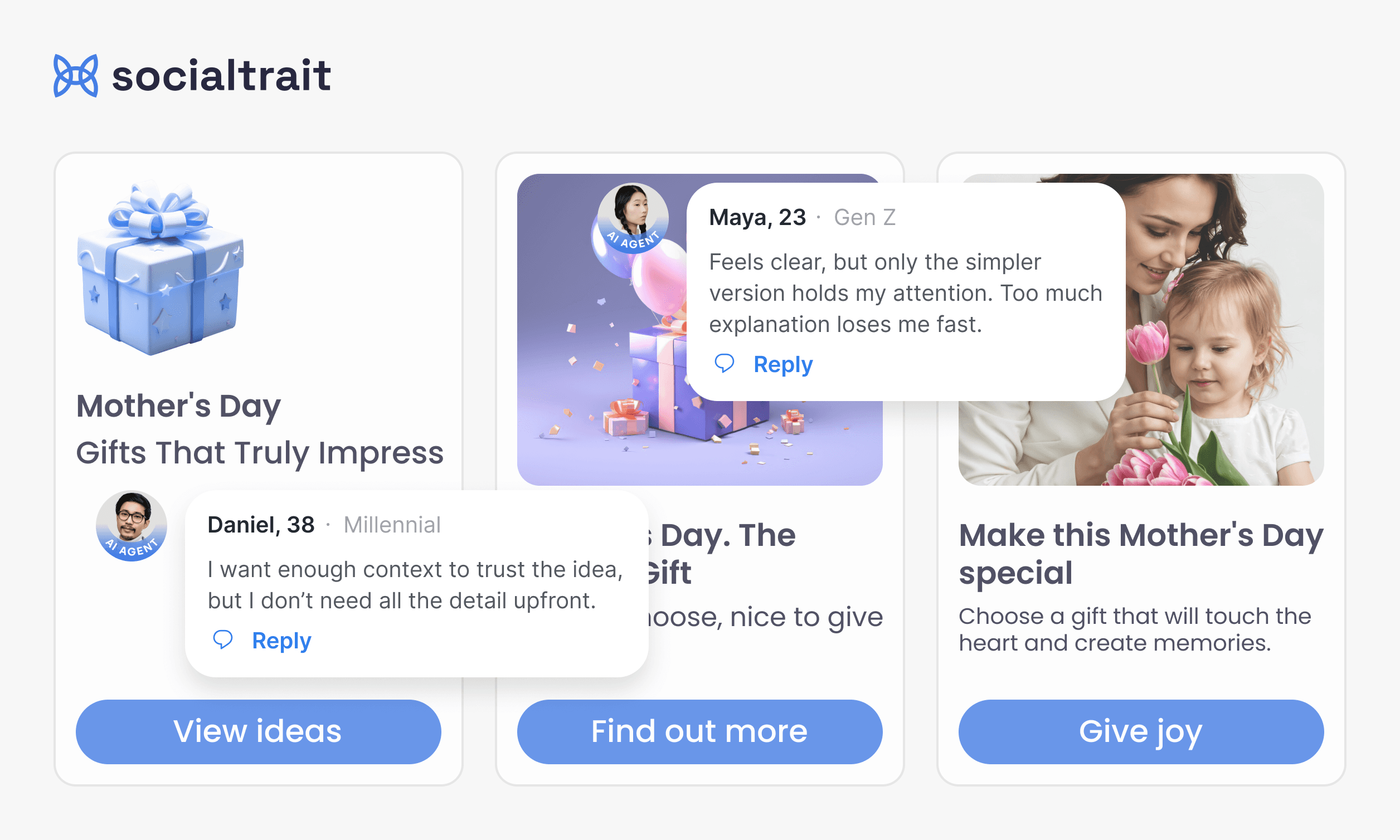
Table of contents
In September 2025, Socialtrait was granted a U.S. patent for its proprietary system that generates and activates AI-powered synthetic personas in research environments. This isn’t just a technical milestone it formalizes a new category in the consumer insights stack: AI audience simulation.
As marketing, product, and research teams race to keep up with shifting audience behaviors, the real question is no longer “can we run a focus group?” but “can we simulate how different audiences will react before we invest in anything real?”
Now, with over 1 million AI agents representing segmented demographics and psychographics, Socialtrait offers exactly that: a simulation platform that complements traditional research and scales it.
What Is a Synthetic Audience?
A synthetic audience is a group of AI-generated agents trained to behave like real consumers. These agents are modeled with:
Demographics (age, region, income, etc.)
Psychographics (values, needs, identity drivers)
Behavioral history and cognitive patterns
Emotional and cultural context
They debate, interpret, and form opinions just like real people but they scale infinitely faster and without panel fatigue.
This is not generative text. This is reinforcement-trained behavior modeling, now protected by patent.
What Brands Are Already Using Synthetic Audiences To Do
Compare different versions of a brand story and see how emotional response shifts by demographic and mindset
Understand which creative elements (not just visuals, but tone, pacing, CTA) trigger interest, confusion, or drop-off
Predict how a message might polarize or spread across different social mindsets
Pre-test campaign ideas across specific synthetic communities (e.g., “urban Gen Z, values-led,” or “family-first, middle-income Midwest”)
In a recent project, a global brand simulated emotional response to five versions of a rebrand before launch. One version triggered confusion in legacy customers; another failed to generate recall in younger audiences. The winning version scored well across both and was rolled out with confidence.
Socialtrait’s Synthetic Audiences vs Traditional Research: What’s the Difference?
Feature | Traditional Research | Synthetic Audience Simulation |
Recruitment | Weeks of panel setup, often limited in scope | Instant audience generation by profile or behavior |
Sample Size | 6–20 (qual) / 500–1000 (quant) | 500 to 50,000+ agents per simulation |
Speed | 2–6 weeks | Under 48 hours |
Segmentation | Mostly demographic | Demographic + psychographic + behavioral |
Bias Risk | High (social desirability, groupthink) | Low (simulated agents operate independently) |
Cost | $15k–$250k+ per study | 10–30x more cost-efficient |
Emotional Context | Requires skilled moderation | Modeled and reinforced using contextual prompts |
Data Output | Responses + coded insights | Natural discussion + pattern recognition + dashboards |
Scalability | One study at a time | Unlimited parallel studies |
Real-World Validation | Directly from real people | Modeled but tested for correlation to actual behavior |
Synthetic audiences are a new layer in the research stack. They let your team move faster, explore more, and go deeper before committing real budget or production effort.
Why This Matters Now
Today’s teams need insights fast, not just what people see, but how they interpret and talk about it.
Synthetic audiences enable:
Instant segmentation without recruiting panels
Emotional, behavioral, and perceptual feedback
Testing at scale, before you spend on media, production, or rollout
It’s not about replacing human feedback. It’s about simulating risk and resonance early — when you still have time to adapt.
Can We Trust Synthetic Insights?
Skepticism around synthetic audiences is natural. When insights don’t come from direct human respondents, the first question is always about validity:
Do these simulations reflect real-world behavior or just theoretical models?
What’s important to understand is that synthetic insights are not designed to replace human judgment or traditional research. They are built to augment it, especially at early stages where speed, breadth, and risk detection matter most.
This mirrors what we are already seeing across adjacent disciplines. In product development and R&D, AI is increasingly used not as a replacement for engineers or researchers, but as a collaborative accelerator helping teams simulate outcomes, test assumptions, and reduce uncertainty before committing resources.
At the 2025 R&D Leaders Forum, McKinsey highlighted how AI-powered simulation and agent-based systems are now actively used in:
virtual product testing,
concept validation,
iterative experimentation,
and early-stage risk detection
across industries such as automotive, aerospace, medtech, and industrial engineering.
The same logic applies to consumer research.
Just as engineers use AI to simulate physical systems before building them, marketing and insights teams can use synthetic audiences to simulate consumer response before launching ideas into the market.
Recent research cited by McKinsey shows that synthetic personas can replicate human feedback with 70–95% accuracy, particularly for:
first-impression reactions,
message clarity,
emotional tone,
and segment-level differences in interpretation.
This makes synthetic audiences especially valuable upstream when teams are comparing narratives, stress-testing creative directions, or identifying where a message may confuse, polarize, or fail to land.
At Socialtrait, this trust is further reinforced by how the system is built. Our platform uses reinforcement learning–based persona generation, designed specifically for research environments rather than conversational chat. Personas are evaluated, selected, and activated based on relevance, consistency, and engagement signals allowing simulated communities to reason, disagree, and evolve responses over time.
This is not about generating content.
It is about generating behavioral signal.
Synthetic insights don’t replace human research. They expand its reach, compress timelines, and surface risks earlier when teams still have the ability to adapt.
What It Changes
The most valuable insights today are not reports. They’re early warnings.
Synthetic Audiences let your team explore the edges. They help you spot friction, misalignment, or wasted spend before it happens. You can simulate responses across 20 versions of an idea and get a signal on which is most likely to work by segment, sentiment, and storyline.
It’s research that keeps pace with execution.
The Next Layer of Strategy
If your brand is in the middle of a transformation, a campaign cycle, or a positioning shift, the question is simple:
Do you know how different audiences will respond before you launch?
If not, now you can.
Closing
Socialtrait didn’t start with a platform. It started with a question:
Can we simulate how audiences will respond before they actually do?
Today, with our simulation engine, synthetic audience models, and now a U.S. patent to protect our method, we’re proud to say: yes, we can.
Whether you're preparing for a global launch, stress-testing a brand idea, or refining positioning across segments, you no longer have to wait for the market to give you the answer.
You can simulate the future, then build toward it.
Talk to us about how Socialtrait helps insight, brand, and creative teams de-risk decisions and scale confidence.
Request a demo →